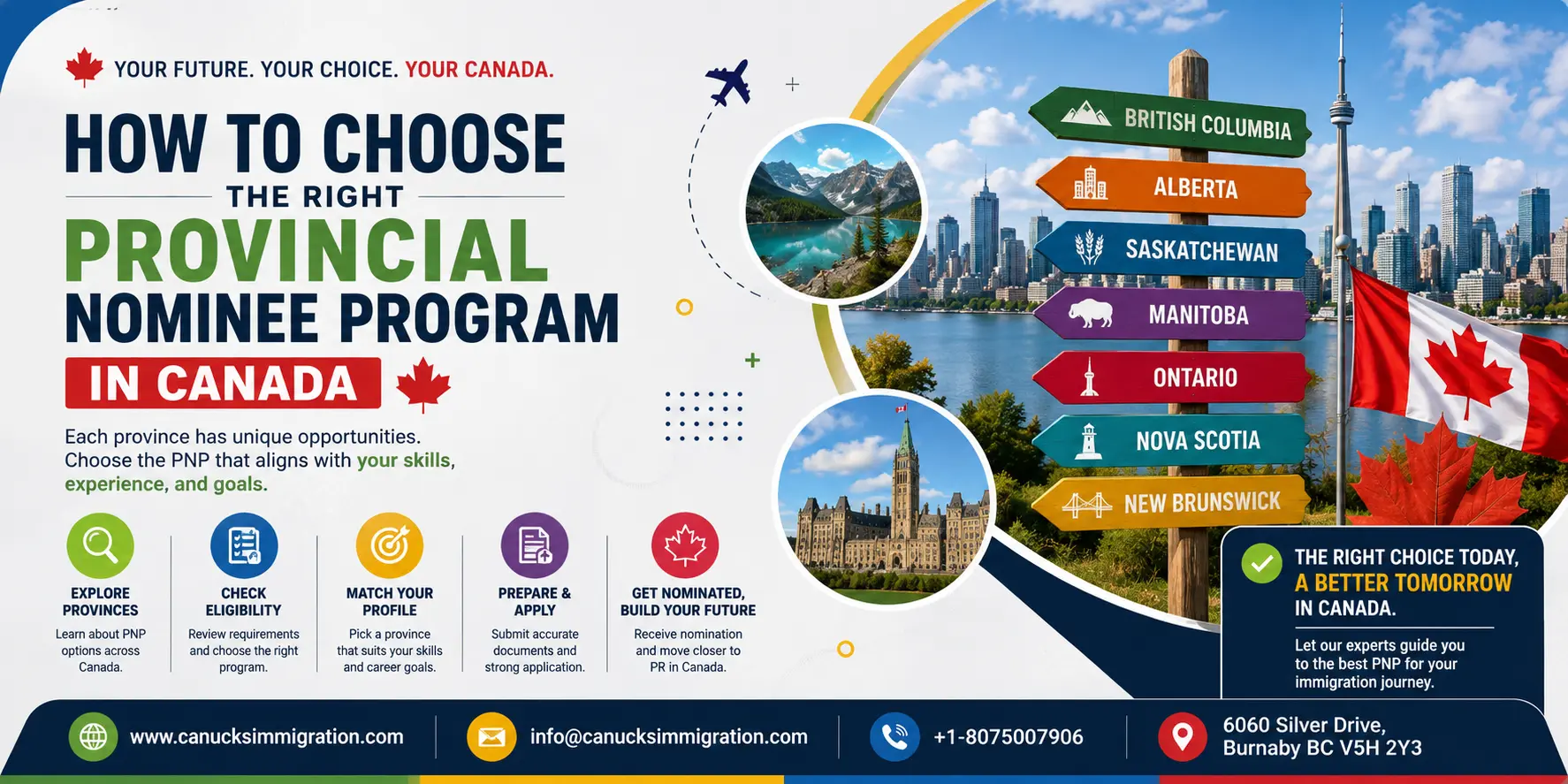
The Canada’s provincial nominee program provides another route of the skilled workers to permanent residence as it enables the provinces and territories to nominate the skilled workers according to their economic and labor-market requirements.
Key Takeaways
- Choose a province based on your occupation, education, experience, language score, and settlement plans.
- Express Entry-linked nominations can provide 600 additional CRS points toward Canadian permanent residence.
- Job offers and provincial connections can strengthen eligibility for certain PNP immigration streams.
- Each province has different occupation priorities, eligibility rules, selection systems, and nomination requirements.
- The right PNP depends on your profile rather than simply choosing the easiest province.
The selection of the PNP is not, however, just a matter of finding the province that has the lowest score or shortest processing time. Your job, education, work experience, language skills, Express Entry profile, job opportunity and ties to a given province can all have an effect.
The most appropriate approach is to take time and get to know your profile and then match it with the existing programs.
What Is the Provincial Nominee Program in Canada?
The provincial nominee program enables the involved provinces and territories to choose candidates who can help to build their local economies. Every province has its own streams and creates the requirements according to its labor-market priorities.
There are two broad types:
- Enhanced PNP: Connected to Express Entry. A nomination can add 600 CRS points.
- Base PNP: This is an immigration system that works outside Express Entry and operated by the province itself.
The requirements are quite diverse, and this is why there is no particular PNP that can apply to every applicant.
How to Choose the Right PNP
1. Check Whether Your Occupation Is in Demand
One of the initial factors to research is your occupation. Occupations with labor shortages are often targeted by provinces.
Depending on the province and the immigration targets, healthcare, technology, engineering, skilled trades, education, agriculture, and other areas can be prioritized.
Determine your NOC occupation and compare it with the occupation that various provincial streams aim at.
2. Review Your Provincial Nominee Program Eligibility
Understanding provincial nominee program eligibility is a key issue that needs to be comprehended prior to application. Depending on the stream, requirements might include:
- Education
- Language proficiency
- Skilled work experience
- Occupation or NOC
- Job offer
- Canadian education or work experience
- Provincial connections
- Settlement funds
- Express Entry profile
Minimum requirements do not necessarily lead to an invitation since certain provinces operate on a points system, Expressions of interest (EDIs) or targeted draws.
3. Consider Your Express Entry CRS Score
Your CRS score will be particularly significant when you take into account some Express Entry-related pathway.
If your CRS score is not competitive for a direct Express Entry invitation, PNP for Express Entry can provide a significant advantage. A provincial nomination adds 600 CRS points, greatly increasing the likelihood of receiving an Invitation to Apply.
Nevertheless, those candidates who are not eligible to Express Entry can have a provincial base pathway that might suit them better.
4. Check Job Offer Requirements
A Canadian employment opportunity can enhance your profile although it is not obligatory to all provincial streams.
Others are based on occupation, education, work experience, language skill or other criteria, whereas others are based on an eligible employer and a qualifying position.
When you already have a job offer, focus on provinces where it helps you in this respect.
5. Consider Your Provincial Connections
Relationships like family, past education, employment or Canadian work experience could be useful to some programs.
As such, the province with the lowest reported threshold may not always be the best province to apply for PNP. A province of which you have a valid relationship may provide you a better door.
Compare Canadian PNP Options
The comparison provided below can assist you in determining the provinces which might match various applicant profiles. Requirements and priorities may vary, and therefore, always ensure that you check up on the existing provincial criteria before submitting an application.
| Province | Main PNP Focus | Job Offer | Suitable For |
| Saskatchewan | Skilled workers and targeted occupations | Depends on stream | IT, healthcare, engineering, trades |
| Manitoba | Skilled workers and provincial connections | Depends on stream | Overseas applicants, healthcare, IT |
| Alberta | Skilled workers, technology and rural pathways | Depends on stream | Technology, engineering, rural applicants |
| British Columbia | Skilled workers and targeted occupations | Depends on stream | Technology, healthcare, graduates |
| Ontario | Skilled workers and graduates | Depends on stream | Professionals and graduates |
| Nova Scotia | Labour-market and Express Entry priorities | Depends on stream | Healthcare, skilled workers |
| New Brunswick | Skilled workers and regional needs | Often stream-specific | Skilled and bilingual applicants |
| PEI | Skilled workers and regional labour needs | Depends on stream | Agriculture, healthcare, hospitality |
Which PNP May Suit Your Profile?
Instead of searching only for the “easiest” program, match your background with provincial priorities.
| Your Profile / Situation | What to Look For | PNP Options to Research |
| No Canadian job offer | Streams where a job offer is not required | Saskatchewan, Manitoba, Nova Scotia |
| Strong Express Entry profile | Enhanced PNP streams aligned with Express Entry | Ontario, Alberta, British Columbia |
| Recent Canadian graduate | Graduate or international graduate pathways | Ontario, British Columbia, Manitoba |
| French-speaking applicant | French-language or bilingual pathways | New Brunswick, Ontario |
| Willing to live in a smaller community | Rural or regional immigration pathways | Alberta, New Brunswick, PEI |
| Have an eligible employer/job offer | Employer-driven PNP streams | Manitoba, Saskatchewan, New Brunswick |
| Occupation is in demand | Streams targeting priority occupations or labour-market needs | Saskatchewan, Alberta, Nova Scotia |
Provinces Worth Considering
Saskatchewan
Saskatchewan has the potential to be appealing to skilled workers whose professions match the provincial labor-market requirements. Its programs may be applicable professionals in technology, healthcare, engineering, and skilled trades.
Manitoba
Manitoba provides an avenue to skilled personnel and prioritizes aspects like education, work experience, language proficiency, and affiliations with the province.
Alberta
Alberta can be the place of technology professionals, skilled workers, and interested in rural community’s candidates. Its routes may be focused on particular economic and labor-market priorities.
British Columbia
Technology professionals, healthcare workers, skilled workers and international graduates can find British Columbia appealing, but there might be increased competition in the popular pathways.
Ontario
Ontario has a number of avenues to skilled workers and international graduates. As it is a very popular destination, applicants must thoroughly examine the existing requirements of streams instead of just depending on CRS scores.
Atlantic Provinces
Nova Scotia, New Brunswick, Newfoundland and Labrador, and Prince Edward Island operate programs designed around regional labor-market needs. These may be worth considering when your occupation and settlement plans align with their priorities.
Should You Choose the Easiest PNP?
The easiest PNP might be the one that one chooses. A province can also have a seemingly lower threshold but this will be inappropriate since your occupation, experience, or other qualifications are not aligned to its current priorities.
Instead, ask:
Which province offers the strongest match for my profile?
An example of this is that a technology professional could make use of a technology-related pathway whereas a healthcare professional could make use of a healthcare-related stream.
PNP for Express Entry vs. Base PNP
An enhanced PNP for Express Entry requires an eligible Express Entry profile. A provincial nomination can add 600 CRS points and significantly improve the candidate's position in the federal system.
A base PNP works independently of Express Entry and may be of use to those candidates who lack an appropriate Express Entry route.
Both are not necessarily superior. The decision you make is based on your eligibility, qualification and the needs of the province at the time.
How to Strengthen Your PNP Profile
Once you identify suitable programs, focus on improving your overall profile:
- Improve your language score: Higher language results can strengthen your federal and provincial profile.
- Complete your ECA: An Educational Credential Assessment may be required when using foreign education for immigration purposes.
- Document work experience: Keep detailed employment letters and supporting records.
- Explore suitable job opportunities: A qualifying Canadian job offer can benefit certain streams.
- Keep Express Entry information updated: Update your profile when your circumstances change.
- Prepare documents early: Organizing identity, education, employment, language, and financial documents can reduce delays.
Why Choose Canucks Immigration for Your PNP Strategy?
The selection of a PNP is not just about identifying a province with low threshold. You must decide which of these routes best suits your qualifications as well as long-term immigration objectives.
Canucks Immigration assists the applicants in evaluating the appropriate Canadian immigration options, provincial criteria, preparing documents and guiding the nomination process.
You can match your occupation, education, work experience, language skill, Express Entry profile, and various other criteria with professional assistance and then find the most appropriate PNP strategy.
Conclusion
The selection of the appropriate provincial nominee program requires a profile-based approach. Take into account your job, education, language score, work experience, Express Entry status, job offer and provincial links before choosing where to apply.
The best province to apply for PNP is one that your qualifications match the existing immigration priorities and eligibility criteria.
The provincial programs and selection criteria may vary, so applicants must always ensure that they look at the current requirements and then apply.